From a Forest Kindergarten in Odense to Kindergartens in China
Marianne Olesen discovered that children are children – whether they grow up in Denmark or China.
After almost four decades as an early childhood educator, Marianne Olesen decided to take early retirement. But rather than slowing down completely, she took on a completely new challenge: spending three weeks as a volunteer Danish early childhood educator in Chinese kindergartens through Learn For Life.
“I decided to take early retirement while I am still young and strong enough to try something new in life – perhaps China,” she wrote when applying to join the programme.
The decision led to an experience that left a lasting impression on her, both professionally and personally. Marianne travelled to China in May and spent time in three nature kindergartens in Shijiazhuang, south of Beijing, as well as Weihai and Luoyang.
Nature as a learning environment
Marianne has worked in kindergartens for 35 years – most of that time in a forest and sports kindergarten. Nature, physical activity and community have been a common thread throughout her professional life. These were exactly the skills and experiences she brought with her to China, together with a strong belief that educators should be positive role models for children.
“When we are curious and playful ourselves and dare to be a little unconventional, it becomes much easier to engage children and spark their interest. I believe we create trust, joy and genuine relationships when we are authentic, dare to give a little more of ourselves – and sometimes even dare to laugh at ourselves.”
Playing instead of explaining
Marianne experienced great interest from children, educators and parents alike. Her approach to play, in particular, sparked curiosity.
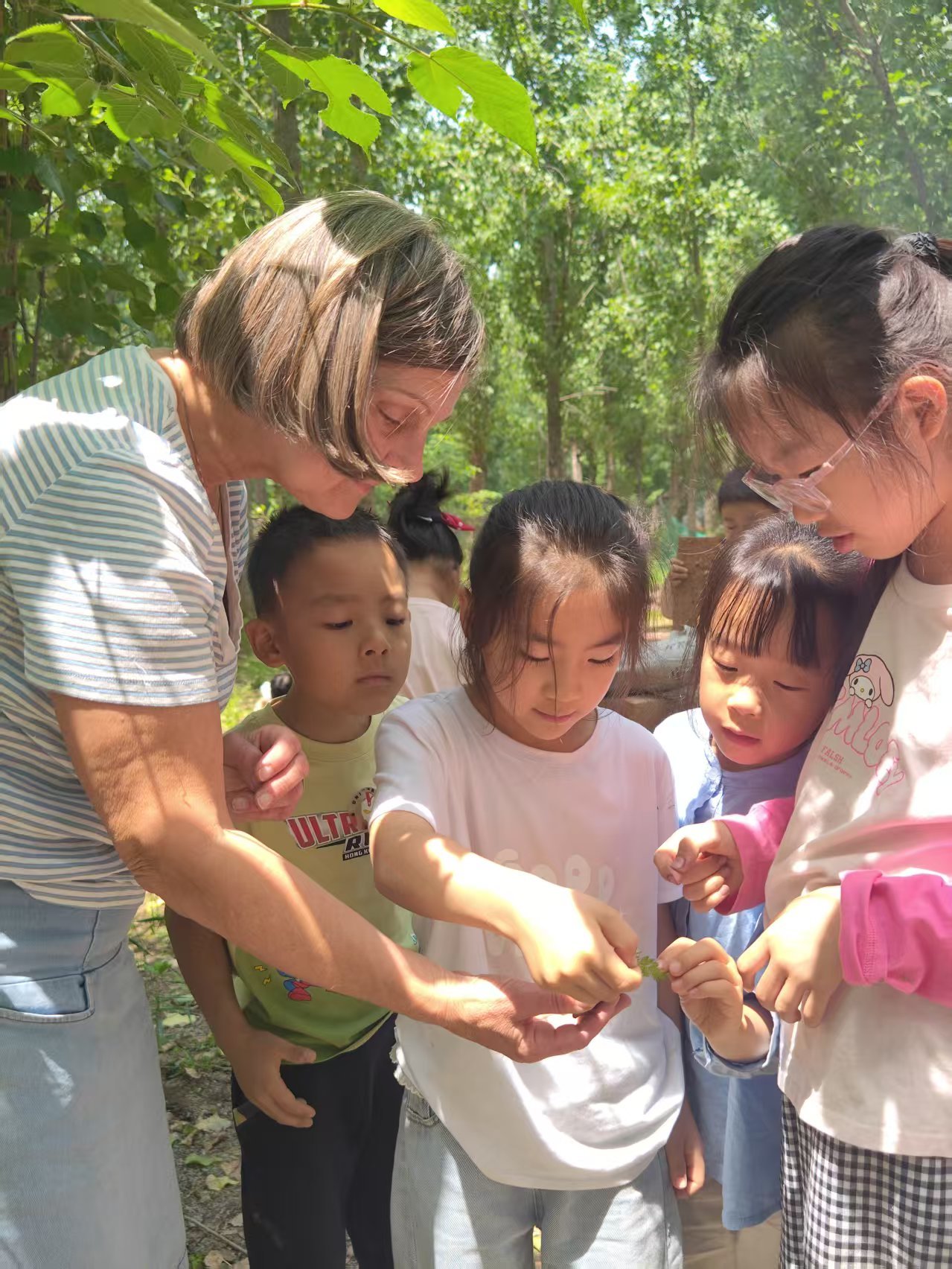
She introduced movement games, freeze dance, singing games, and rhymes combined with movement. At the same time, she actively used nature as part of the activities. Rain, slopes, branches, stones, berries and hammocks all became natural elements of play and learning. She also introduced something that surprised many of the Chinese educators: children can use real tools – including saws and knives. For Marianne, good early childhood education means that adults participate actively alongside the children.
“Educators need to be active together with the children. They need to dare to play and be silly. Not everything has to be explained and planned.”
She also found that working with longer-term projects was a new approach for many of the educators she met. “Chinese educators could benefit from thinking more in terms of projects that develop over several days or weeks – rather than focusing on a single lesson.”
Body language became their common language
“Play, facial expressions, movement and smiles often proved far more powerful than digital translation,” Marianne explains. Despite the language barrier, she quickly found non-verbal ways of communicating with the children.
During the first two weeks, Marianne also benefited greatly from the support of Learn For Life’s colleague in China, Ann Guo Skov, who helped with translation. This was particularly important during professional meetings with educators and parents. There was especially strong interest in nature and outdoor life, play, and Danish approaches to early childhood education in general.
Before leaving Denmark, Marianne had prepared three presentations: one about herself, one about her Danish kindergarten, and one about the Danish strengthened pedagogical curriculum. All three proved to be very useful during her stay.
A stay that required flexibility
During her time in China, Marianne stayed in several different hotels – ranging from very basic to comfortable – and for one period she stayed at a kindergarten.
The working days were long. She typically worked seven to eight hours a day with a break in the middle of the day, as well as five to six hours on Saturdays. In addition, there were social activities and sightseeing, often organised at short notice. For this reason, Marianne believes that flexibility is essential for future participants. They need to be able to manage independently, adapt quickly to changing circumstances, come up with new ideas and be willing to improvise.
Children are children
The strongest – and perhaps most surprising – impression Marianne brought home was just how much Danish and Chinese children have in common despite their different cultural backgrounds. “They are fascinated by the same things as Danish children – small creatures, stones, water and mud. They have the same curiosity, the same desire to play and the same joy in exploring nature.” For Marianne, her stay in China was a reminder that relationships, play and shared experiences are a universal language – and that early childhood education is, above all, about meeting children with presence and trust, and having the courage to become part of their play.